
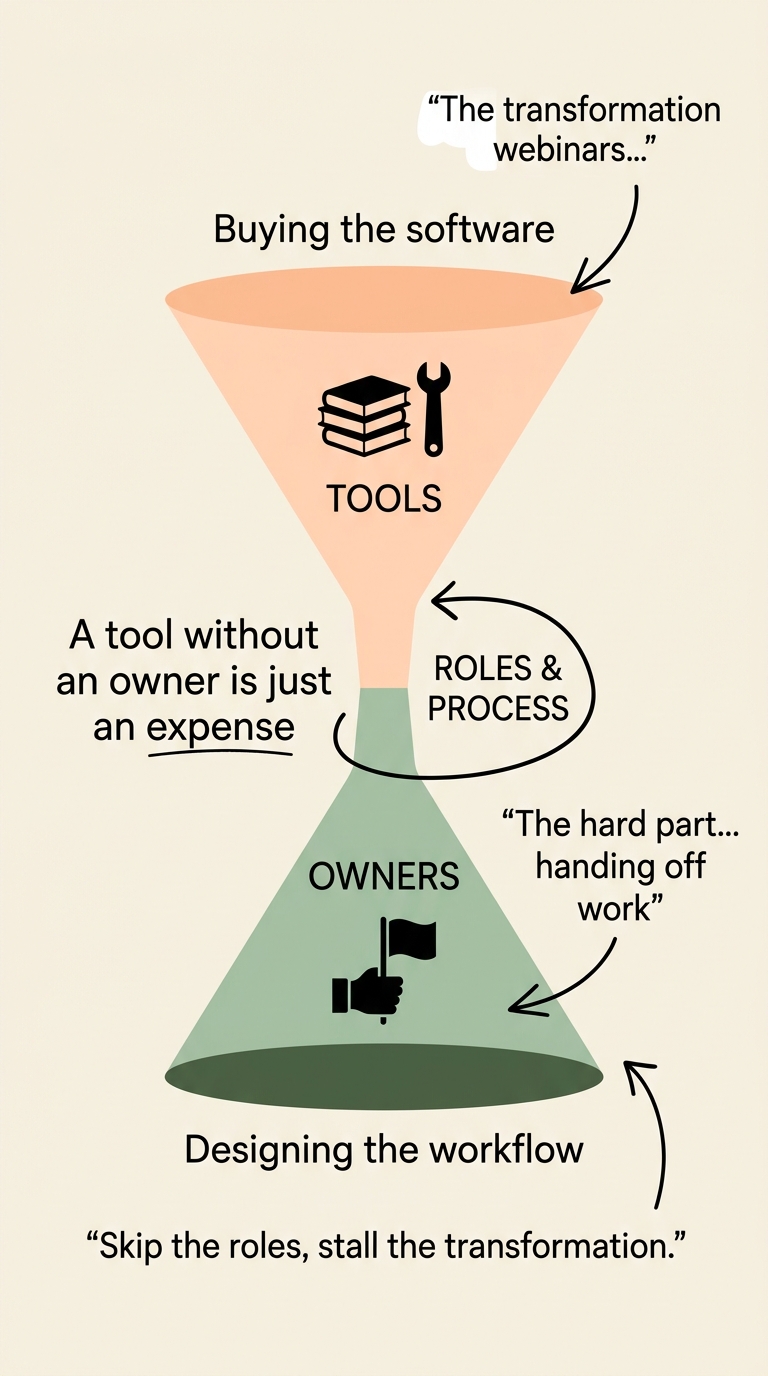
Most AI initiatives fail not because the technology is wrong, but because nobody owns the work. Companies buy the tools, run the pilot, then look around the room and realize everyone assumed someone else was responsible. That silence is expensive. The roles needed for successful AI adoption in business are not complicated, but they are specific, and skipping them is the single most reliable way to turn a promising AI investment into a shelf-ware story.
This is the part nobody talks about in the "AI transformation" webinars. They show you the tools. They show you the use cases. They do not tell you that a tool without an owner is just a subscription cost waiting to be cancelled.
Why Most AI Projects Die in the Implementation Phase
The pain is not usually technical. It is organizational. A founder or operations lead spends three months evaluating AI vendors, signs a contract, and then the whole initiative quietly stalls. Tickets go unresponced. The prototype from the kickoff call never gets connected to real data. The team reverts to the old spreadsheet because nobody formally handed off responsibility for the new system.
This happens in companies of all sizes, but it hits small and mid-sized businesses hardest. Enterprise companies have entire IT departments and transformation offices to absorb the friction. An SMB with 20 to 80 employees does not have that buffer. The founder is still in the weeds. The operations lead is fighting fires. The person who was supposed to "own the AI stuff" also owns six other things and has no formal mandate to prioritize the new system over the old ones.
The result is what we call manual drag at its worst: the business is paying for AI tools that are technically running, but practically disconnected from how work actually gets done. The silo problem did not go away. It just got more expensive.
What People Have Already Tried (and Why It Did Not Work)
The most common response to this problem is to hire a junior "AI person." Someone fresh out of a bootcamp, or a smart intern who seems enthusiastic about ChatGPT. The logic makes sense on paper: get someone dedicated to this, and the problem is solved.
But the junior AI hire almost always fails for the same reason. They can build things, but they do not have the business context to know what to build. They create one-off automations disconnected from how the company actually operates. They do not know the margin structure, the client relationship history, or the operational bottlenecks that have been quietly compounding for years. So they build technically functional tools that solve the wrong problems. Three months in, nobody is using the tools, and leadership quietly concludes that "AI is not ready for our business."
The other common attempt is to spread AI adoption responsibilities across the existing team informally. Everyone gets a ChatGPT license. Someone posts a few prompt tips in Slack. A manager volunteers to "keep an eye on it." This is shadow-tasking at scale, which sounds like progress but produces chaos: inconsistent outputs, security gaps, no institutional knowledge being built, and still no clear owner of the actual transformation work.
The Real Problem: AI Adoption Is a People Architecture Problem
Here is the reframe most companies need. AI adoption is not a software problem. It is a people architecture problem. The question is not "which tool should we buy?" It is "who is responsible for what, and do they have the mandate, the context, and the time to do it?"
This matters because the right AI strategy requires three distinct types of thinking operating simultaneously: strategic thinking (what should we automate and why), technical thinking (how do we build and connect the systems), and operational thinking (how do we get the team to actually use the new way of working). Almost no single person is equally strong in all three. The businesses that succeed at AI adoption assign these responsibilities deliberately, even if one person wears two hats out of necessity.
What follows is a practical breakdown of the roles needed for successful AI adoption in business. Not a corporate org chart. A functional map of who needs to own what, sized for the reality of a small or mid-sized business.
The Roles Needed for Successful AI Adoption in Business
The AI Strategy Owner (the Architect)
This role exists to answer one question: where does AI create the most leverage for this specific business? Not for the industry. Not based on what a vendor is selling. For this company, with this margin structure, these clients, and these operational constraints.
In most SMBs, this role belongs to the founder, CEO, or a senior operations lead. It does not require deep technical knowledge. It requires business judgment, an understanding of where the most expensive manual drag lives, and the authority to allocate resources toward fixing it. The AI Strategy Owner is responsible for the roadmap, the prioritization decisions, and the relationship with any external AI partners.
The critical thing this person must resist is abdicating the role entirely to a vendor or consultant. External partners can diagnose and build, but the strategy owner has to stay close enough to the work to make judgment calls. The roadmap should be owned internally, even if it is co-created externally.
The AI Implementation Lead (the Builder)
This person takes the strategic priorities and turns them into working systems. They are the one connecting the CRM to the project management tool, building the prompt logic for the proposal generator, testing the automated triage workflow before it goes live. They are technical, but their effectiveness is multiplied when they understand the business context behind what they are building.
For most SMBs, this role is either outsourced to an AI implementation partner, or it lives with a technically capable internal hire who has been given explicit time and mandate to focus on it. The biggest mistake is asking this person to split their time equally between AI implementation and their previous responsibilities. Implementation work requires focused attention. A split-attention builder is a slow builder, and slow implementations stall and die.
The Change Champion (the Bridge)
This role is the most underrated in the entire people architecture. The Change Champion is not a technical role. It is a trust role. Their job is to stand between the new AI-powered workflows and the team members who are skeptical, scared, or just too busy to learn something new.
The fear is real. Staff who have spent years doing data entry, building reports, or managing handoffs between systems are often afraid that automation means their job disappears. A Change Champion addresses that directly, shows the team what the new workflow actually looks like in practice, and reframes their role from "person who does the task" to "person who manages the system that does the task." This is not cheerleading. It is serious change management work, and without it, even the most technically perfect AI implementation will see adoption rates in the basement.
In smaller businesses, the Change Champion is often a respected team lead or a manager who is already trusted by the frontline staff. The role does not need to be formal, but it needs to be intentional. Someone has to own the human side of the transition.
The Data Steward (the Gatekeeper)
AI systems are only as good as the data they touch. And most SMBs have data spread across 10 to 15 disconnected platforms: a CRM that has not been cleaned in two years, a project management tool with inconsistent naming conventions, a QuickBooks file that only one person knows how to navigate. Before any AI workflow can reliably automate a process, someone has to own the integrity of the underlying data.
The Data Steward is responsible for understanding where the company's data lives, whether it is clean enough to feed into an automated workflow, and what security protocols need to be in place to ensure proprietary information is not leaking into public AI training models. This is not a full-time role in most SMBs, but it needs to be a named responsibility. "Nobody owns the data" is how a well-intentioned AI tool ends up generating proposals with wrong pricing, or worse, surfacing confidential client information in places it should never appear.
This connects directly to the question of which AI tools are actually appropriate for your business. General AI tools handle your data very differently than purpose-built vertical solutions. The Data Steward needs to know the difference and make sure every tool in the stack has been evaluated for it.
The Process Owner (the Operator)
Every AI workflow that gets built should have a Process Owner: the person responsible for the business outcome that workflow is designed to serve. If the AI system is automating proposal generation, the Process Owner is probably the person who was previously responsible for proposals manually. If the AI system is triaging incoming support tickets, the Process Owner is the customer success lead.
The Process Owner is not responsible for building or maintaining the technology. They are responsible for knowing whether it is working. They set the success criteria upfront (this workflow should cut proposal turnaround from 3 days to 4 hours), they monitor the outputs for quality, and they flag when something is drifting or breaking. Without Process Owners, AI workflows run without accountability, and small errors compound into big problems before anyone notices.
What This Looks Like in a Real SMB
In a professional services firm with 30 employees, these five roles might be distributed across three or four people. The founder is the AI Strategy Owner. A senior analyst or operations manager doubles as the Change Champion and holds the Process Owner role for the workflows in their department. A part-time contractor or an AI implementation partner serves as the Builder. The finance or ops lead takes on Data Stewardship as a secondary responsibility.
That is a realistic people architecture for a business at this size. It does not require new headcount. It requires deliberate role assignment and protected time. The difference between an SMB that succeeds at AI adoption and one that does not is rarely the quality of the tools. It is usually whether someone had a clear mandate and enough time to do the role well.
David R., Operations Lead at a manufacturing company, put it plainly after working through an AI audit: the most high-leverage thing the process surfaced was not a new tool. It was the discovery that multiple overlapping responsibilities had no clear owner, and the inefficiencies compounding from that gap were costing the business six figures annually. The technology solution came after the organizational clarity.
How Do You Know Which Roles You Are Missing?
The fastest diagnostic is to ask one question for each role: who is responsible for this, and when did they last make a decision about it? If the answer is "I think it is [name], but I am not sure," the role is unowned. If the answer is "we all kind of share it," the role is unowned. Shared ownership with no named accountable person is the same as no ownership.
Most SMBs that come to us for the first time are missing the Change Champion and the Data Steward entirely. The Strategy Owner is often present but not protected from day-to-day firefighting enough to actually do the role. The Builder is either absent or split across too many other responsibilities. The Process Owner role has never been formally considered.
Identifying these gaps is the starting point of a serious AI transformation. Understanding the roles needed for successful AI adoption in business is not a theoretical exercise. It is the work that makes every other investment in technology worthwhile.
Start With a Diagnostic, Not a Tool Purchase
If you are serious about AI adoption and you want to avoid the implementation graveyard that claims most AI pilots, the right first step is not buying another platform. It is getting a clear map of where your biggest operational drag lives, what your current people architecture looks like, and what needs to change before any new technology can actually stick.
Our AI Transformation Audit does exactly that. In a focused diagnostic session, we find the single most expensive manual process in your business and build a working prototype to replace it in under 7 days. More importantly, we help you understand who needs to own what for the change to last after we leave. You walk away with a roadmap, not just a demo.
If you want to start smaller, take the free AI Readiness Assessment first. It maps your current tech stack, identifies where data is siloed, and translates your operational inefficiencies into a dollar figure. Most businesses that go through it find that the number is larger than they expected, and the organizational gaps are clearer than they realized.
The tools are ready. The question is whether your people architecture is.
Frequently Asked Questions
Do small businesses really need all of these roles for AI adoption?
Not as separate headcount, no. In a small business, one person can hold two or three of these roles simultaneously. The important thing is that each function is explicitly assigned to someone with the time and mandate to do it, rather than assumed to be "everyone's job" by default.
What are the most critical roles for AI adoption in a business just starting out?
The two most critical roles for successful AI adoption in business are the AI Strategy Owner and the Change Champion. Without strategic direction, you build the wrong things. Without a Change Champion, even the right things get ignored by the team. Start there before worrying about the rest.
How do we handle the fear that AI will replace jobs?
Directly and early. The Change Champion role exists specifically to address this. The framing that works is not "AI is not replacing anyone" (which people often do not believe) but rather "here is what your role looks like after this workflow is automated, and here is why it is a better job." Concrete role evolution beats reassurance every time.
Should the AI Implementation Lead be internal or outsourced?
Either can work, but the decision should be based on the scope and timeline of your transformation, not on what is cheapest in the short term. An internal hire builds institutional knowledge over time but needs real focus time and business context to be effective. An external partner can move faster on technical build but needs strong internal strategy ownership to stay aligned with what the business actually needs.
How does the Data Steward role connect to AI security concerns?
Directly. The Data Steward is the person responsible for ensuring proprietary client or business data is not flowing into public AI training models or accessible via tools that were not evaluated for compliance. In industries with regulatory requirements like healthcare or finance, this role often needs to interface with legal or compliance as well. Skipping it is one of the fastest ways to create a serious security or trust problem.
What is the biggest mistake companies make when assigning roles for AI adoption?
Assigning roles without protecting time. A person who is named the AI Strategy Owner but still spends 90 percent of their week in operational firefighting cannot do the role. The roles needed for successful AI adoption in business only work when the people holding them have enough protected time to actually execute, not just a new title on an already overloaded job description.