

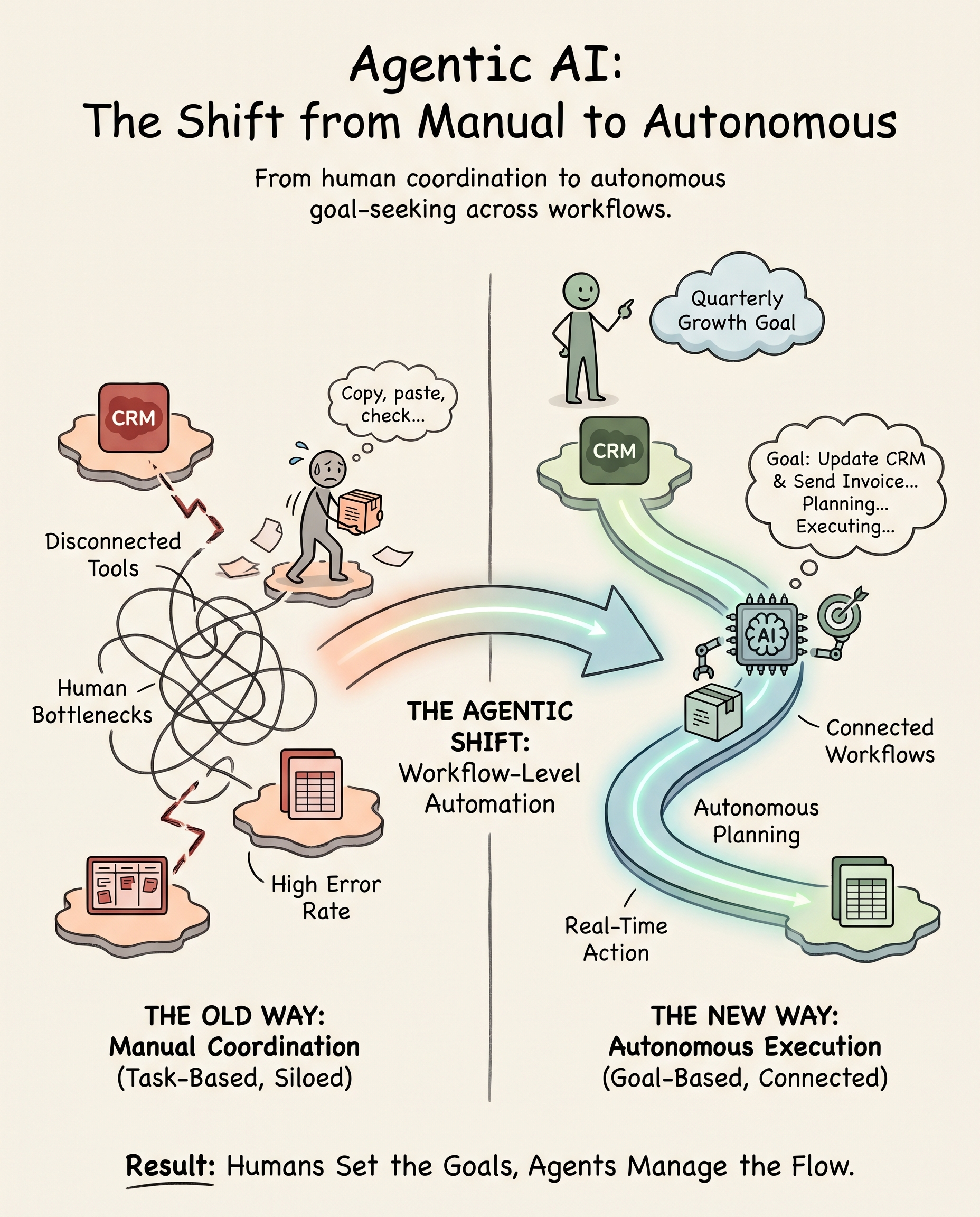
Agentic AI is the biggest change in how businesses run since cloud software. Here's what it is, why many early attempts stall, and what to do before you spend a dollar.
Key takeaways
- Agentic AI works toward a goal. It plans, makes decisions and acts across your software with little hand-holding. That's a different kind of help from the chat assistants you've probably tried.
- Adoption is already wide. A PwC survey found 79% of senior executives say AI agents are running in their companies, so waiting has a cost.
- Map the work first. The businesses getting the best returns mapped their business processes before they bought a platform.
A PwC survey of 300 senior executives shows how fast this has moved. 79% say AI agents are already running inside their companies. And 66% of those using them report real productivity gains. For your business, that means agents have moved past the experiment stage at many of the companies you compete with.
Most owners I talk to can feel that something has shifted. What's less clear is what agentic AI actually is, how it differs from the AI they've tried and how to tell a real deployment from a slick demo. Let's clear that up.
What is agentic AI, in plain terms?
AWS defines agentic AI as an autonomous program that acts on its own to reach a goal you set. Thomson Reuters describes it as AI that plans and carries out complex tasks across several apps. It makes decisions and uses your apps without you guiding each move.
Here's the plain version. A generative AI tool answers when you ask it something. An agentic assistant pursues a goal. You tell it the outcome you want. It plans the steps, uses the software it has access to, checks its progress and adjusts when something changes. You stay in charge of the goals and the oversight, and the agent handles the routine steps.
MIT Sloan adds a useful detail. The strongest setups use several specialized agents that work together. One reasons, one finds information and one carries out actions, all aimed at one outcome. Think of a well-run team where each person knows their role.
So what does this mean for you? Generative AI makes one person faster at a task. Agentic AI can take whole categories of manual coordination off your team's plate.
Why the AI you've tried hasn't changed much
Subscriptions to AI features. The usual first step is a chat assistant for the team, plus the AI features inside your CRM and project management app. These speed up single tasks. They don't connect one part of the business to the next. Someone drafts a proposal faster and someone else summarizes a meeting. But the data still doesn't move from the CRM to the proposal to the project record by itself. A person still carries it across.
The one-off pilot. The second pattern is a contractor or platform that builds one thing, like a support chatbot or a lead scoring app. These can be useful alone. They stall when it's time to connect them to the rest of the business. A chatbot can answer common questions, but it can't update the CRM, create a follow-up task and flag the account without a person bridging those apps. This is a common reason AI projects fail: the process underneath was never mapped or connected.
Buying the label. The third pattern is buying an "agentic" platform because the category is hot. MarketsandMarkets projects the agentic AI market will grow from $7.06 billion in 2025 to $93.2 billion by 2032. Money like that attracts vendors, and some sell a label more than a capability. If a person still has to trigger each action, check each output and push results onward by hand, the product is generative AI with new marketing.
Here's a practical test. Have the vendor show you exactly which actions the software takes on its own, from start to finish.
The real constraint sits in how work moves through your business
The question owners usually ask is "which agentic AI tool should we buy?" That jumps to an answer before anyone has found the real constraint.
In most small businesses, the constraint is the same. The steps live in people's heads, and each app runs on its own. The CRM doesn't talk to the project management app. The accounting software doesn't share margin data with operations. Agentic AI can bridge those gaps, but only if you can see them. You can't automate what you haven't mapped.
History has a good parallel. In 1913, Henry Ford's plant introduced the moving assembly line. Each station did one job and passed its work to the next, and the whole line moved together. Output rose and the cost per car fell. The breakthrough was a new way of organizing work, and agentic AI asks the same thing of your business.
The data points the same way. A Google Cloud study of executives found that 13% qualify as "agentic AI early adopters." These companies put half or more of their future AI budget into agents and build them deep into operations. Among them, 88% report a return from AI in at least one use case, compared with 74% of everyone else. The gap comes from how they approached the work, before any software was chosen.
What does this mean for you? Treat agentic AI as a decision about how your business is organized. The platform comes after you know which workflow you're redesigning, and why.
How to prepare before you buy anything
Here's the check I'd run before you look at a single platform. It has three steps, and you don't need a vendor for any of them.
- Find your biggest manual handoff. This is the moment a person takes information from one system and carries it into another, with no judgment added. Think proposal details retyped from the CRM, or invoice lines copied from a project tracker into accounting. These handoffs pay back fastest, because the work is well defined and repetitive.
- Put a dollar figure on it. Multiply the weekly hours by the fully loaded hourly cost of the people doing it. Then multiply by 50 working weeks. A task that eats 8 hours a week at $60 an hour adds up to $24,000 a year. Plenty of businesses have several routines like that.
- Map the data an agent would need. Write down where the input lives and which systems it touches. Then describe what a good output looks like and where it needs to go. If you can answer those clearly, you're ready to compare platforms. If you can't, a platform won't fix it.
Also: How to build an AI strategy that actually maps to your business
This check turns a vague interest in agents into a specific, costed project.
What does agentic AI look like in a small business?
The use cases that deliver share a pattern. They're high-volume, well-defined jobs where a person currently moves information between systems.
- Proposal drafting. An agent pulls client data from the CRM, pricing from your rate card and scope wording from your templates. It then builds a first draft for a person to review. A job that took over an hour can drop to minutes.
- Support triage. An agent sorts incoming requests by type and urgency and finds relevant answers in your help docs. It drafts a reply and routes the ticket to the right person with the context attached.
- Status updates across systems. An agent watches project milestones, updates the CRM and sends the client a status note. It flags any budget problem for the account manager.
PwC's survey shows where companies deploy agents most: customer service (57%), sales and marketing (54%), and IT and cybersecurity (53%). Those are the teams with the most repetitive handoffs. The same logic applies to AI in operations and process improvement.
Start by looking for your repetitive coordination work first. That's where an agent will earn its keep.
Who stays accountable when an agent acts?
The European Data Protection Supervisor describes agentic AI as systems that act on their own with limited human involvement. That raises a question to answer before you deploy anything. Where does human oversight sit, and who is accountable when the agent gets something wrong?
That's a reason to be deliberate, not a reason to wait. The businesses that deploy agents well build escalation into the design. The agent handles defined cases on its own and sends unusual ones to a person. It also logs its actions so your team can check them. Thomson Reuters describes a similar approach, with experts shaping each agent and people handling oversight and exceptions.
For your business, it comes down to three questions. Which decisions can the agent make alone? Which should it flag for review? And how will you know if it makes mistakes? Clear answers are what make an agent your team trusts.
Also: How to build an AI-ready organization before the software goes live
Ready to find where agentic AI fits in your business?
Our complimentary AI Readiness Assessment maps how work gets done today and finds the automation opportunities worth the most. It turns that gap into a dollar figure, with nothing to buy and no platform to evaluate.