

How to Build an AI Strategy

AI strategy April 2, 2026 14 min read

Buying AI tools isn't a strategy. Learn the step-by-step framework SMB leaders use to build an AI strategy that shows up on the P&L — not just the software bill.

Most businesses don't have an AI strategy. They have an AI shopping list. A ChatGPT license here. An "AI-powered" feature tacked onto the CRM there. A junior hire tasked with "figuring out the AI stuff." And somehow, six months and $30,000 later, nothing has actually changed. The spreadsheets are still open. The data is still siloed. The team is still drowning. If you want to build an AI strategy that actually works — one that shows up on your P&L, not just your software bill — you have to start by admitting that buying tools is not the same thing as building a strategy.

Why Most SMBs Are Stuck in the Wrong AI Conversation

Here's the pain nobody wants to say out loud: your team is already using AI. They're just using it badly. Someone has a personal ChatGPT tab open for drafting emails. Someone else is running client data through a free tool with no idea where that data is going. And leadership? Leadership is watching a flood of LinkedIn posts about AI agents and automation and wondering whether they're falling behind — while simultaneously not knowing which move to make first.

This is what we call manual drag with an AI veneer on top. The underlying processes haven't changed. The data silos are still there. The coordination tax — all those hours employees spend managing handoffs between apps, teams, and tabs — is still bleeding you dry. You've added AI noise to an already broken system. That's not a strategy. That's chaos with better branding.

The emotional experience of this moment is specific. It's not ignorance. It's paralysis. You've read enough to know something has to change. You've seen enough case studies to believe AI is real. But the gap between "AI is transforming business" and "here's the next thing I should actually do on Monday morning" feels impossibly wide. Every tool promises to be the answer. Every consultant wants to sell you a workshop. And you're standing in the middle of it all, trying to protect your margins and your team at the same time.

Why Everything You've Already Tried Hasn't Worked

Before we get to the framework, let's be honest about the graveyard. Most businesses have already tried several things that seemed reasonable at the time.

The first move is usually the SaaS upgrade path. You notice your project management tool now has an "AI assistant" button, so you pay for the upgrade. Then your email platform launches an AI writing feature. Then your CRM adds predictive scoring. You end up paying 20–30% more across your entire software stack for AI features that don't talk to each other, don't connect to the rest of your data, and don't actually solve the process problem underneath. You haven't automated anything. You've just made the subscriptions more expensive.

The second move is the junior AI hire. You bring in someone — a recent grad, a bright marketing coordinator, a self-taught "AI enthusiast" — and hand them the mandate to "figure out how we can use AI." This person is usually talented and eager. But they're operating without a map. They don't have the business strategy context to know which processes are actually costing you money. They build a chatbot for the website and a content template in Notion and call it a win. Meanwhile, the proposal generation process that consumes 12 hours a week per account manager goes untouched.

The third move is the webinar circuit. You sign up for three AI for Business workshops, consume 14 YouTube videos, and download a PDF called "The Ultimate AI Playbook for SMBs." You feel informed. You feel motivated. And then Monday arrives and there's still no clear next action. Theory overload is real, and it's one of the most expensive forms of procrastination a leader can indulge in.

None of these failed because you made bad choices. They failed because they all share the same flaw: they start with tools, not with problems. A real strategy works in the opposite direction.

The Reframe: You Don't Have an AI Problem. You Have a Process Debt Problem.

Here's the shift that changes everything. AI is not a product category you need to adopt. It's a capability you can apply — but only where there's an identifiable, measurable process underneath it.

Every hour your team spends copying data from one app to another is process debt. Every manual handoff between sales and ops is process debt. Every Friday afternoon your office manager spends reformatting a spreadsheet that was already built somewhere else is process debt. This debt accumulates invisibly. It rarely shows up as a line item. It shows up as fatigue, overtime, hiring requests, and a nagging sense that the business is working harder than it should for the revenue it's generating.

When you try to bolt AI onto process debt, you get faster chaos. When you map the debt first — identify exactly where time is disappearing and why — AI becomes a precise tool for eliminating specific costs. That's the difference between an AI shopping list and an actual strategy.

Think of it this way: you wouldn't hire a Formula One pit crew for a car that hasn't had its oil changed in three years. The high-performance tooling can't save a broken foundation. The businesses winning with AI right now aren't the ones with the most tools. They're the ones who did the diagnostic work first.

How to Build an AI Strategy That Actually Works

What follows is the framework we use at Vantage Leap. It's not complicated. But it requires honesty — about where your business actually is, not where you wish it were.

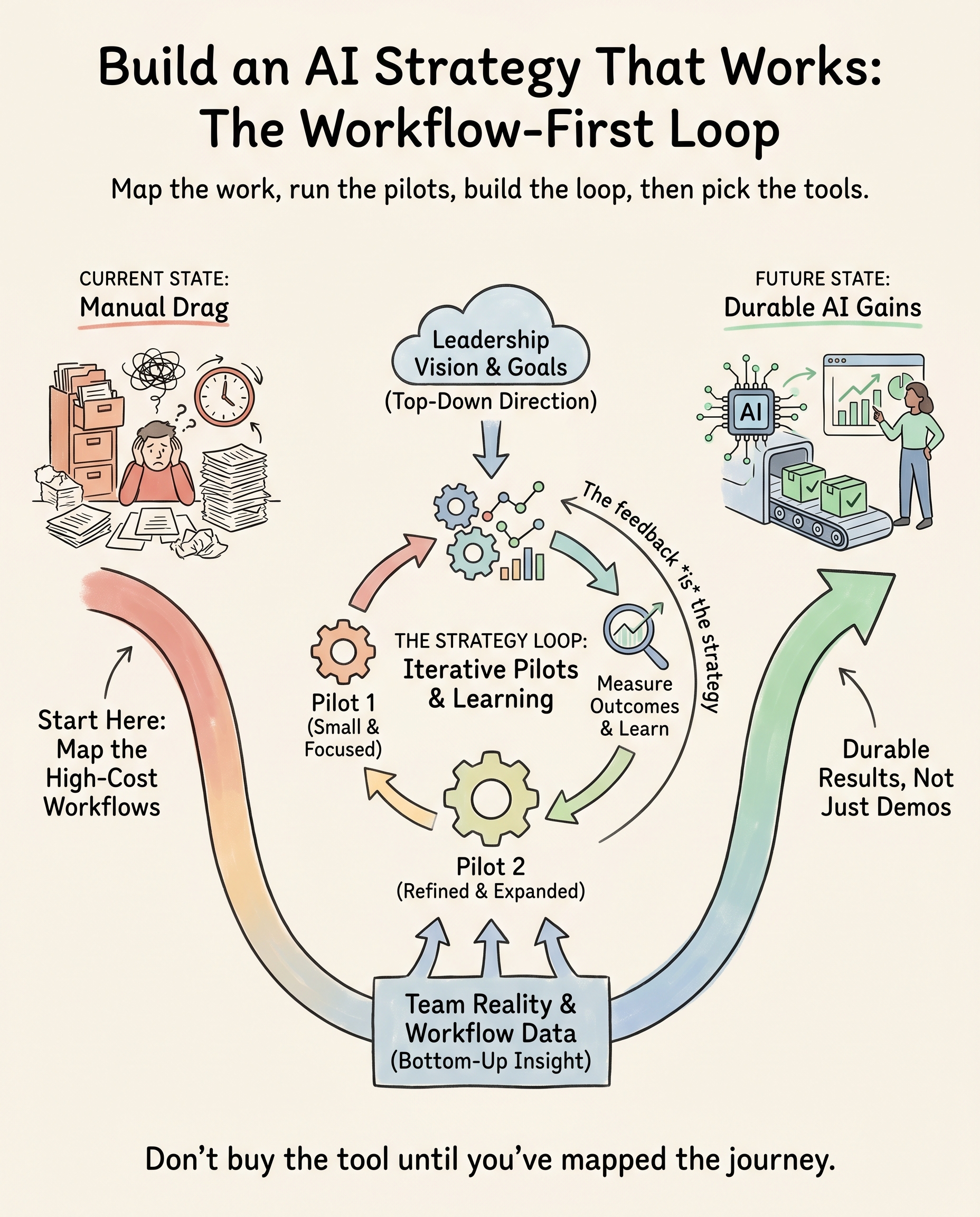
Step 1: Map the Process Debt Before You Touch a Single Tool

Start with a week of honest observation. Ask every department lead one question: "What's the most repetitive thing your team does that feels like it shouldn't require a human?" Write down every answer. Then add up the time. Convert it to dollars using fully-loaded hourly costs. This number — your weekly manual drag cost — is the foundation of your strategy. It's also the number that will justify every future investment to your CFO, because you're not guessing at ROI anymore. You're working backward from a known waste figure.

Common answers we hear: generating proposals from CRM notes. Reconciling invoices between accounting and project management. Triaging and routing inbound support tickets. Updating client-facing status reports from internal tracking tools. Every one of these is a candidate for automation. Your job at this stage is to list them, rank them by cost, and resist the urge to solve any of them yet.

Step 2: Identify Your One Best First Move

A common mistake when businesses try to build an AI strategy is trying to automate everything at once. This always fails. The tech debt multiplies. The team gets overwhelmed. The integrations break under the weight of too many simultaneous changes. Instead, identify the single highest-cost manual process on your list and treat it as your pilot.

The right pilot has three qualities. First, it's measurable — you can count the hours before and after. Second, it's bounded — it doesn't require changing every system in the company simultaneously. Third, it's painful enough that your team will actually adopt the solution, because the old way is clearly worse. Proposal generation, invoice reconciliation, and intake triage are almost always strong pilots. They're contained, they're repetitive, and everyone involved knows they're broken.

Step 3: Build the Connective Tissue, Not Just the Automation

This is where most DIY AI implementations fail. They automate a task inside one system without connecting it to the rest of the workflow. You get an AI that drafts proposals — but it's pulling from a static template, not live CRM data. You get a chatbot that answers questions — but it can't update a ticket status or escalate to the right person.

A real AI strategy treats your tools as a system. The goal is connective tissue — an integration layer that lets data flow from where it lives to where it needs to go, without a human manually moving it. When your CRM talks to your project management platform, which talks to your accounting software, which surfaces a margin alert when a project runs over budget — that's an agentic architecture. That's what changes the economics of the business, not a single clever prompt.

This is also where the security question becomes non-negotiable. Any workflow that touches client data, pricing information, or internal financials needs explicit protocols for where that data goes. Proprietary information should never enter a public training model. Your AI strategy isn't complete until your data governance plan is complete. Protecting your data as you automate isn't optional — it's what separates a trustworthy implementation from a liability.

Step 4: Staff the Transformation, Not Just the Tools

One of the things we see kill otherwise well-designed AI implementations is the human layer. Leadership buys the technology. Nobody explains to the team why it exists, how it changes their role, or what they're supposed to do with it. Resistance builds. Workarounds emerge. The expensive system gets quietly abandoned.

Your team is not the obstacle. They're the variable. The employees who were spending three hours a day on manual data entry don't disappear when you automate those three hours. They need to know what they're doing instead. The most effective AI strategies we've seen are paired with a clear answer to that question — and often with structured training that moves people from AI novices to capable operators. Teaching your team to work alongside AI is a force multiplier for everything else you build.

Step 5: Measure in Weeks, Not Quarters

One of the clearest signs of a healthy AI strategy is that it produces measurable results fast. Not in a year. Not after a six-month implementation. If your first pilot doesn't show a meaningful change in hours or cost within 30 days, something is wrong with the scope. Either the problem wasn't as bounded as you thought, or the solution is over-engineered for the current state of the business.

We built our own methodology around this principle. The Aspirin Solution — identifying the single most expensive manual process and replacing it with a working prototype in under seven days — exists because fast feedback is what builds organizational confidence. When your team sees a real process replaced by a real automation in real time, the skepticism drops. The next conversation about the roadmap gets easier. The CFO starts asking what else you can automate, instead of whether you should.

What This Looks Like in Practice

David R., an operations lead at a manufacturing company, came to us skeptical. He'd been through the SaaS upgrade cycle and the junior AI hire cycle and had nothing to show for either. His exact words: "The most high-leverage 30 minutes of my career." That was his description of our initial audit — not because we told him anything magical, but because we translated his process debt into a specific dollar figure. The audit revealed inefficiencies he didn't know were costing his company six figures annually. Not as an estimate. As a line-by-line accounting of where time was disappearing.

That number changed the internal conversation entirely. It moved the question from "should we invest in AI?" to "can we afford not to?" That's the shift a real strategy produces. And it starts not with tools, but with an honest look at what's actually happening inside the business.

For businesses earlier in the process — ones that are still in the "I know something is broken but I don't know what" stage — our AI readiness framework offers a starting point that doesn't require any commitment to tools or vendors. The goal is always clarity before investment.

The One Thing Most AI Strategies Get Backwards

Strategy implies a destination. Most AI strategies skip the destination entirely and go straight to the vehicle. "We're going to implement AI" is not a strategy. "We're going to recover 400 hours of manual labor annually in our proposals process, starting with a pilot in Q1" — that's a strategy. The difference is specificity, and specificity only comes from doing the diagnostic work that most businesses skip because it feels slower than buying software.

It isn't slower. It's the only path that actually works. The 95% failure rate on AI pilots that MIT documented isn't a technology problem. It's a sequence problem. Businesses rush to the tools before they've mapped the terrain. The 5% that succeed are the ones who treated the diagnosis as the first deliverable — before a single line of code was written or a single subscription was purchased.

When you build an AI strategy the right way, something quietly shifts in how the business feels to lead. You stop firefighting and start architecting. The decisions get cleaner because the data flows where it needs to go. The team stops being buried in administrative debt and starts doing the work you actually hired them to do. That's not a technology outcome. That's a leadership outcome. And it starts with one honest question: where is our time actually going?

Ready to Build Your AI Strategy Without the Guesswork?

If you've been reading this and thinking "I know we have process debt but I don't know exactly where" — that's exactly what our AI Transformation Audit is built for. For $497, we do a deep-dive diagnostic of your business, map the specific workflows that are costing you the most, and hand you a prioritized roadmap with a working prototype of your highest-value automation built in under seven days. No theory. No slide decks full of AI buzzwords. A real plan, built for your actual business.

Or if you're earlier in the process and want to see the numbers before committing to anything, our free AI Readiness Assessment translates your current operational inefficiencies into a dollar figure — so you walk away knowing exactly what your process debt is costing you annually. No pitch. No pressure. Just clarity.

Let's transform your business together.

Frequently Asked Questions

What's the first step to build an AI strategy for a small business?

The first step is a process audit — not a tool evaluation. Map every repetitive manual task in the business, estimate the time cost, and convert it to dollars. This gives you a clear picture of where AI will produce measurable ROI before you spend a dollar on software.

How long does it take to see results from an AI strategy?

A well-scoped pilot should produce measurable results within 30 days. If your first automation doesn't show a meaningful reduction in time or cost within a month, the scope is too broad or the problem wasn't properly defined. Start smaller and more specific.

Do I need a technical background to build an AI strategy?

No. The strategic layer — identifying which processes to automate and in what order — is a business problem, not a technical one. You need to understand your workflows, your costs, and your team's capacity. A good implementation partner handles the technical build.

How do I build an AI strategy without putting client data at risk?

Any AI strategy that touches client data needs explicit data governance protocols before deployment. This means knowing exactly where your data goes, ensuring proprietary information doesn't enter public training models, and building security into the workflow architecture from day one — not as an afterthought.

What's the difference between buying AI tools and having an AI strategy?

Buying tools is a procurement decision. Building a strategy means identifying the specific business outcomes you want, mapping the processes that currently block those outcomes, and then selecting or building the automations that address those specific bottlenecks. Strategy starts with the problem, not the product.

How much should a small business budget to build an AI strategy?

The budget should be proportional to the cost of the problem you're solving. If your highest-cost manual process is burning $80,000 a year in labor, a $5,000–$15,000 implementation investment has a clear and defensible ROI. The mistake is buying tools before you've quantified the problem — because without that number, every spend feels like a gamble.

Ready to take the next step?

Schedule a complimentary discovery call and let's talk about where AI fits in your business.

Schedule a Discovery Call →