

How to build an AI-ready organization in 12 months even if your team is skeptical

AI readiness April 22, 2026 15 min read

Building an AI-ready organization isn't about picking the right software. It's about sequence, skepticism, and starting with the most expensive workflow you have.

How to build an AI-ready organization in 12 months even if your team is skeptical

Most business leaders assume the hard part of becoming an AI-ready organization is choosing the right software. Pick the wrong tool, and you've wasted six months. Pick the right one, and the transformation practically runs itself. That assumption is wrong — and it's the reason most AI initiatives stall before they ever produce a dollar of measurable value.

The hard part isn't the software. It's the people sitting in the Tuesday morning standup who've heard the word "AI" seventeen times this quarter and still aren't sure if it means they're getting replaced, getting retrained, or getting ignored. Skepticism isn't a personality flaw. It's a rational response to a decade of failed enterprise tech rollouts and breathless hype that never delivered what it promised.

So before I walk you through a 12-month plan for building an AI-ready organization, I want to say this plainly: your team's skepticism is data. It tells you exactly where the resistance lives and where to start. The leaders who treat it as an obstacle tend to bulldoze through it and then wonder why adoption flatlines six weeks after launch. The leaders who treat it as information tend to build something that lasts.

Why most AI transformations fail before month three

The pattern is almost always the same. A founder or senior leader attends a conference, gets energized by a keynote on agentic AI, and comes home with a mandate: we are going to become an AI company. They buy a stack of tools. They announce the initiative in a company-wide email. They assign an enthusiastic junior employee to "own" the AI rollout. And then six weeks later, the tools are barely used, the junior employee is overwhelmed, and the skeptics in the room are quietly saying "I told you so."

What went wrong? Usually three things, in this order.

First, the initiative launched as a technology project instead of a workflow project. When you introduce AI as a tool rather than a solution to a specific painful process, your team has no frame for it. It lands as another software subscription on top of the twelve they're already juggling — what we call the "death by 1,000 apps" problem. They open it once, don't immediately see how it replaces anything they're doing, and quietly close the tab.

Second, the business never mapped its actual workflows before asking AI to improve them. You cannot automate a broken process and call it a transformation. You'll just get broken outputs faster. The diagnostic work — mapping where time is leaking, where data is siloed, where handoffs between tools require a human to copy-paste — has to come before the tool selection, not after it.

Third, no one addressed the fear. Staff who believe AI is coming for their jobs will not volunteer to train it, test it, or flag its errors. They'll do the minimum required and wait for the project to die. That's not malice. That's self-preservation. And until leadership names the fear directly and offers a credible alternative narrative, the resistance compounds quietly until the initiative collapses under its own weight.

What does it actually mean to be an AI-ready organization?

Being an AI-ready organization doesn't mean having the most advanced tools or the largest AI budget. It means your workflows are documented clearly enough that an AI agent can follow them. It means your data lives in connected systems rather than scattered spreadsheets and siloed inboxes. It means your team understands what AI can and can't do — not at a theoretical level, but at the level of their actual daily tasks. And it means you have a leadership culture that can absorb change without treating every failure as a reason to retreat.

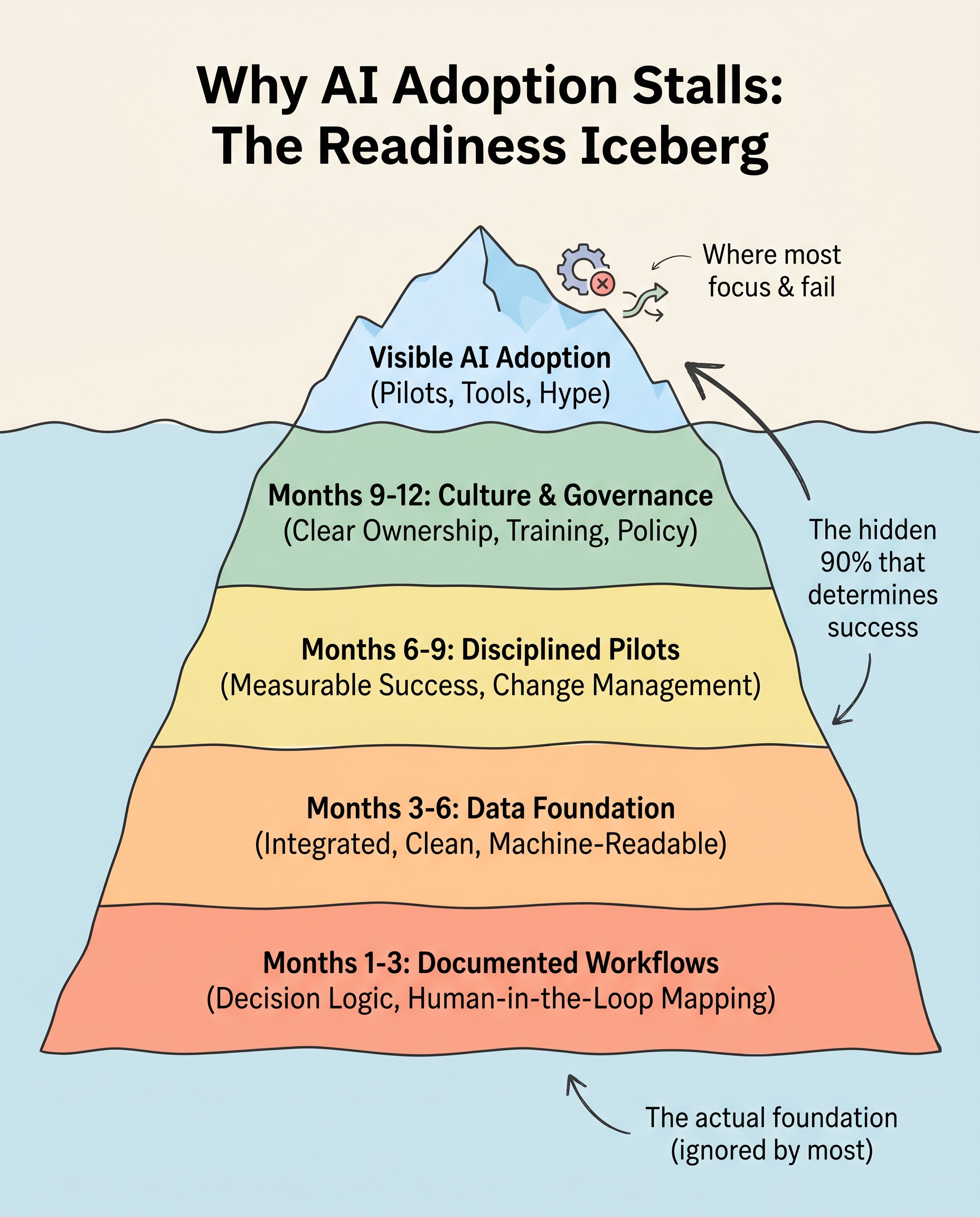
That's a lot to build. But it's entirely achievable in 12 months if you sequence it correctly. The sequence is everything. Most companies try to run all of this in parallel and end up making partial progress on all of it, decisive progress on none of it. What follows is how I'd approach it — quarter by quarter, with specific priorities for each phase.

The 12-month framework: four quarters, four shifts

Quarter one: diagnose before you prescribe

The first 90 days are not about AI. They're about clarity. Before you introduce a single new tool, you need an honest map of how work actually flows through your business — not how the org chart says it flows, but how it actually flows. This means sitting with department leads and asking uncomfortable questions. How long does it take to generate a client proposal? What happens when a support ticket comes in at 4pm on a Friday? Where does data have to be manually re-entered because two of your systems don't talk to each other?

The goal of this phase is to identify what we call the manual drag — the operational friction from repetitive, high-volume tasks that are eating your team's hours and your company's margin. You're looking for the one workflow that, if automated, would produce the clearest and most measurable return. Not the flashiest workflow. Not the most complex one. The most expensive one.

This is also the phase where you conduct an honest assessment of your data infrastructure. Can your CRM write to your project management tool? Does your accounting software share data with your forecasting process? If the answer to either is no, you have a data architecture problem that no amount of AI will solve. AI needs clean, connected data to function. Feeding it siloed, inconsistent data just produces confidently wrong outputs — which is worse than no output at all.

Use this quarter to also take the temperature of your team. Not through an anonymous survey that produces averages, but through direct conversations. What are people afraid of? What are they genuinely curious about? Who are the informal influencers in each department — the people others look to before deciding whether to adopt something new? You need those people on your side before quarter two begins.

If you want a structured starting point, our guide to building an AI strategy walks through the foundational diagnostic questions in more detail.

Quarter two: the aspirin solution

By month four, you should have a clear answer to one question: what is the single most expensive manual process in this company? Now you build an automation for it — not a comprehensive AI overhaul, just one working prototype that replaces that one process.

We call this the Aspirin Solution. It's designed to relieve the most immediate, acute pain before you attempt the bigger transformation. The logic is strategic, not just practical. When your team sees a real workflow genuinely automated — not demoed, not prototyped in isolation, but running in production and saving hours every week — the skeptics shift. Not all of them, and not immediately. But enough of them to generate the internal momentum you need for the next phase.

Be deliberate about what you automate first. It should be a process that's high-frequency, low-ambiguity, and currently time-consuming. Generating first drafts of client proposals from CRM data is a good candidate. Triaging incoming support requests and routing them to the right person before a human has to read them is another. Syncing project status updates across platforms that don't natively integrate is a third. These aren't glamorous. But they're the kind of wins that convert skeptics into advocates because the time savings are immediate and visible.

Document what changes. Track the hours before and after. Calculate what those hours cost at a fully-loaded labor rate. If you automated a process that was consuming 10 hours a week across three employees, and those employees cost an average of $50 an hour fully loaded, you've just recovered $26,000 in annual capacity from one workflow change. That's the number you take to the next company-wide meeting. Not a vision deck. A dollar figure tied to something people already felt was painful.

Quarter three: build the connective tissue

By month seven, you have one real automation running and a team that has at least partially updated its mental model of what AI means for their work. Now you expand — but methodically. The goal of quarter three is to build the connective tissue between your core systems. This is the integration layer that allows data to move automatically between your CRM, your project management tool, your accounting software, and your communication platforms without a human acting as a relay.

This is also where you invest in team capability. Not a one-day AI workshop with a generic slide deck — something more structured and more targeted. Each department needs to understand how to work alongside AI agents in their specific context. Your sales team needs to understand how to use AI to prepare for calls, draft outreach, and update records without the process taking longer than the manual version did. Your operations team needs to understand how to monitor automated workflows and flag when something has gone wrong before it compounds. Your customer-facing staff need to understand how AI handles the routine tier-one requests so they can focus on the escalations that actually require human judgment.

This is also the phase where you establish your security protocols. If staff are using consumer AI tools without guardrails — what we call shadow-tasking — proprietary client data, internal pricing logic, and confidential communications may already be flowing into public training models. A security-first data protocol, established in quarter three, closes that gap and gives your team a clear framework for what they can and cannot share with external AI systems.

Understanding how AI can transform specific customer-facing workflows — including how it affects lifetime value — is covered in depth in our piece on using AI to increase customer lifetime value.

Quarter four: architect the operating model

The final quarter is where most companies think the transformation happens. It's actually where you consolidate and systematize what you've already built. By month ten, you should have multiple automated workflows running, a team that has been trained and is actively using AI tools within a clear security framework, and a data architecture that allows information to flow between systems without manual intervention.

What you build in quarter four is the operating model around all of that. This means documenting who owns each automated workflow. It means establishing monitoring processes so you catch errors before they reach clients. It means creating a clear path for introducing new automations — not ad hoc, based on whoever found an interesting tool this week, but through the same diagnostic process you used in quarter one. And it means building the people architecture — the role definitions, accountability structures, and escalation paths that determine how your team works alongside AI rather than around it.

This is also the quarter where you measure and communicate results. Not to pat yourself on the back, but to institutionalize the transformation. When employees can see that the automations you built have reclaimed hours they used to spend on administrative drag, and that those hours have been reinvested in work that's genuinely more interesting and higher-value, the cultural shift completes itself. The fear that drove early skepticism — "AI is coming for my job" — gets replaced by something closer to "AI is taking the parts of my job I never wanted."

That's the shift that makes an AI-ready organization durable. Not the tools. Not the integrations. The belief, held by the people doing the work, that the technology is working for them rather than against them.

What skepticism actually tells you about your organization

I want to come back to the skeptics, because I think most AI transformation advice treats them as a problem to manage rather than a resource to use. That's a mistake.

The team members who push back hardest on AI adoption are often the ones who know your workflows most intimately. They're skeptical because they've seen what happens when a tool gets implemented without accounting for the actual complexity of the job. They know about the exception cases, the manual workarounds, the judgment calls that happen a hundred times a week and never made it into any process document. That knowledge is exactly what you need when you're designing automations. An automation built without it will fail in ways that are embarrassing and expensive.

So instead of trying to convert skeptics through enthusiasm or mandate them into compliance, involve them in the diagnostic. Make their objections part of the design process. When a skeptic says "that will never work because of X," your response should be "tell me more about X" — because X is probably a real constraint that your automation needs to account for. The leaders who build the most resilient AI-ready organizations are the ones who treated skepticism as a quality control mechanism, not an obstacle.

The 12-month commitment in plain terms

Building an AI-ready organization in 12 months is achievable. It requires a diagnostic phase that maps your actual workflows before you touch a tool. It requires starting with one high-value automation and proving the concept before expanding. It requires connecting your systems so data flows automatically rather than through human relay. It requires training that's specific, practical, and department-level rather than generic and theoretical. And it requires a cultural strategy that treats team skepticism as useful signal rather than inconvenient resistance.

None of those steps are technically complex. All of them require organizational discipline and a clear sequence. The companies that get it right aren't the ones with the biggest AI budgets or the most ambitious roadmaps. They're the ones that stayed patient in quarter one, picked the right first win in quarter two, built the infrastructure in quarter three, and codified the operating model in quarter four.

Twelve months from now, your team can be doing the work you actually hired them for — not moving data between tabs, not fielding the same tier-one questions a hundred times a week, not generating the same report manually every Friday afternoon. That's what an AI-ready organization actually looks like. Not a vision deck. A company where the repetitive work runs itself.

Ready to find out where you actually stand?

The clearest first step toward building an AI-ready organization is knowing exactly where the manual drag is costing you the most — and what it would be worth to fix it. Our complimentary AI Readiness Assessment maps your current tech stack, identifies where data is siloed, and translates your weekly manual hours into annual dollar cost. You'll walk away with a specific, prioritized picture of where AI can move the needle fastest for your business.

If you're past the diagnostic phase and ready to move — to build a working prototype of your most expensive manual process in under seven days — our AI Transformation Audit is the right next step. It's a deep-dive engagement that produces a prioritized roadmap and a working prototype, not a slide deck with recommendations you'll never implement.

Either way, the place to start is clarity. Take the complimentary Readiness Assessment and find out what your manual drag is actually costing you.

Frequently Asked Questions

How long does it realistically take to build an AI-ready organization?

Twelve months is achievable for most small-to-medium businesses if the work is properly sequenced — starting with a workflow diagnostic, moving to a focused first automation, then expanding the integration layer and training. Trying to compress all of it into 90 days almost always leads to adoption failure because the cultural and structural foundations haven't had time to set.

What if my team is too skeptical to engage with the process at all?

Skepticism that complete usually signals that a previous technology rollout went badly — and your team has learned not to invest effort in initiatives that disappear after three months. The fix isn't a better pitch. It's a smaller, more credible first step: one workflow, one automation, a clear before-and-after on hours and cost. A visible win converts skeptics faster than any all-hands presentation.

Do I need to replace my existing software stack to become an AI-ready organization?

Not necessarily. The goal of an AI-ready organization isn't to swap your entire tech stack — it's to connect the tools you already have so data flows between them without human relay. In many cases, the right AI integration layer can make your existing CRM, project management tool, and accounting software work together in ways they never did natively. Replacement is a last resort, not a first step.

How do I handle the fear that AI will replace jobs in my company?

Address it directly and specifically, not with generic reassurance. Identify which tasks within each role will be automated and then articulate clearly what those employees will do with the reclaimed time. When people can see that automation is removing the least interesting parts of their job — not the judgment, relationships, and expertise that make them valuable — the fear tends to shift into something closer to curiosity.

What is the biggest mistake companies make when trying to build an AI-ready organization?

Starting with the tool instead of the workflow. When you buy an AI platform before you've mapped your processes, you're asking the technology to solve a problem you haven't clearly defined. The result is a tool that gets used for a few weeks and then quietly abandoned. The diagnostic has to come first — every time.

How do I measure whether my AI transformation is actually working?

Track the metrics that existed before the automation: hours spent on the specific workflow, error rate, cost per output, and time-to-completion. After the automation runs for 30 days, compare those numbers directly. A 12-hour-a-week process automated across 50 working weeks at a $55 fully-loaded hourly rate is $33,000 of annual drag recovered — that's the kind of concrete P&L impact that justifies the next investment and builds internal confidence in the broader transformation.

Ready to take the next step?

Schedule a complimentary discovery call and let's talk about where AI fits in your business.

Schedule a Discovery Call →