

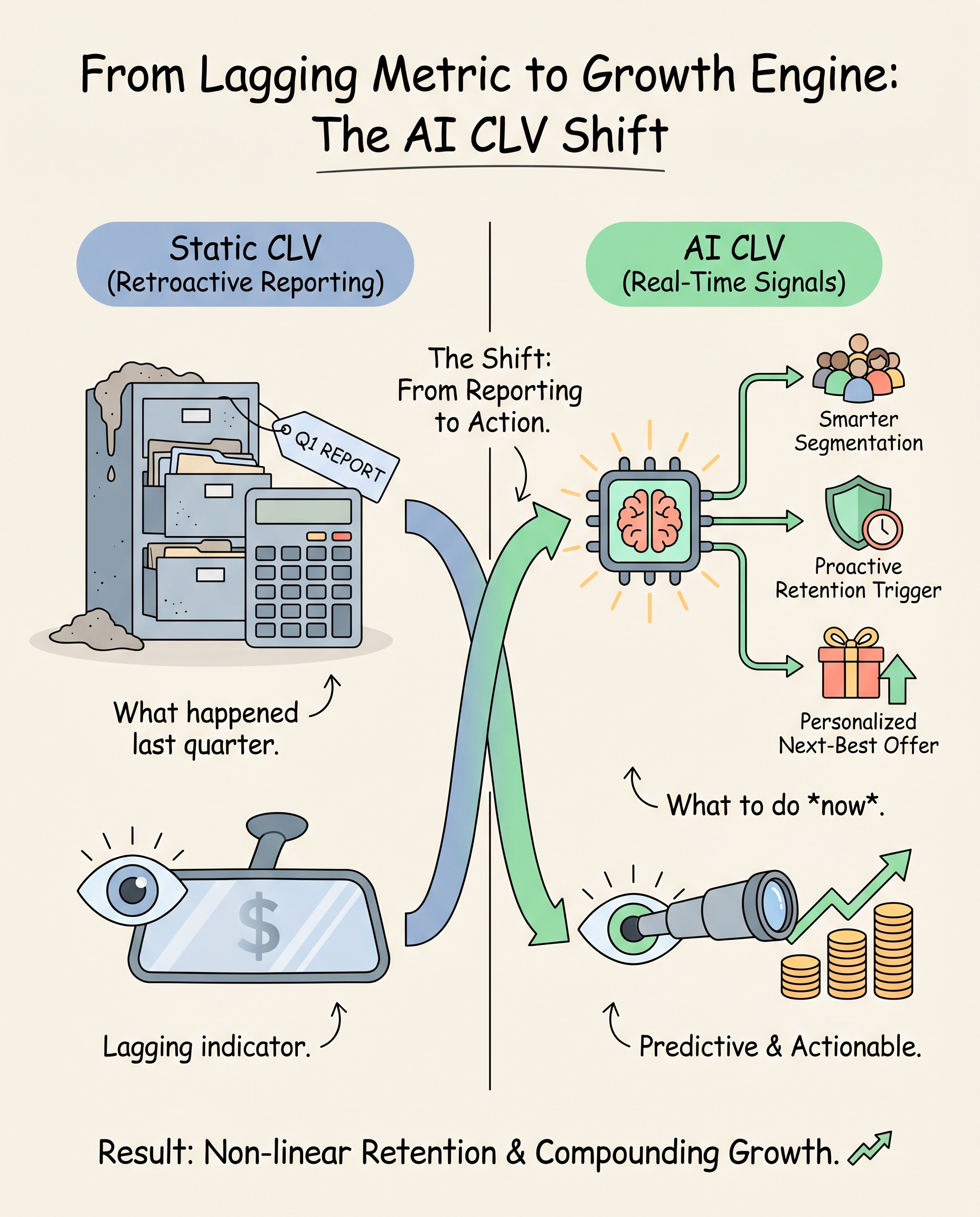
AI can turn customer lifetime value from a report about the past into a live signal you act on. Here's what that means for your business, and where to start.
Key takeaways
- A static lifetime value number looks backward. It tells you what already happened. AI turns it into a signal about what to do next.
- Small retention gains add up fast. A small lift in how many customers stay can produce a much bigger lift in revenue.
- Order matters. AI works best here in three stages: segments that update themselves, then retention triggers, then personalized offers.
What's a 1% change in customer retention worth? According to Sparkco AI's 2025 analysis of lifetime value modeling, even a 1% improvement can lift revenue by 5%. A small change pays back several times over, if you know which customers to focus on.
Most businesses don't know until it's too late. Picture a customer who used to order from you every month. Around spring, the orders slowed. By summer, they stopped. Nobody noticed, because your lifetime value report updates once a quarter, and on paper they still look like a good customer.
That slowdown in spring was a warning. I call it the drift signal: the change in behavior that comes weeks before a customer leaves. AI's role here is to catch the drift signal while you can still act on it. By the end of this piece, you'll know how, in three stages, starting with what you already have.
What does it cost to treat lifetime value as a report?
Customer lifetime value (CLV) is the total revenue you can expect from a customer over the whole relationship. Most businesses that track it do the same thing. They calculate an average, sort customers into rough tiers by purchase history and use those tiers for broad marketing decisions. Useful, but far from what CLV can do.
The trouble is timing. By the time you calculate the number, the moment to act has often passed. A customer who was close to leaving got no attention, because nothing flagged them. A customer who was ready to buy more got the same generic email as everyone else.
For your business, that's revenue lost twice: once from the customer who left, and once from the upgrade nobody offered.
Why do the usual fixes fall short?
Sharper segments. The common response is a better segmentation model, perhaps with RFM scoring (recency, frequency and monetary value). That produces some lift, but it's still a snapshot. It describes where a customer has been. It can't tell where they're heading. A customer who bought often two years ago and then went quiet may have already left, or one well-timed offer might bring them back. A static approach can't tell the difference.
Loyalty programs. Points and reward tiers work where people buy often and switching is easy, like coffee shops and retail. They work less well for professional services or any relationship that's occasional. They also reward what already happened. If a customer is drifting toward a competitor, a points balance rarely changes their mind.
More account management. More check-ins are valuable. But they don't scale, and they spread the same attention across accounts with very different futures. Your team spends hours on customers who were never going to leave and misses the drift signal from those who were.
Each of these fixes helps a little. None of them tells you which customer needs attention right now.
What's the hidden constraint?
CLV is a prediction problem, and most setups treat it as a reporting exercise. The gap sits between your forecast and your next action.
Traditional CLV answers one question: what was this customer worth? AI-driven CLV answers a different one: what is this customer likely to do next, and what should you do about it today? That changes what you collect, the model you build and the routines you connect to it.
A static CLV number is a speedometer that updates once a month. An AI-driven signal works more like a map that updates as you drive.
Digital Applied's guide to AI predictive analytics reports that organizations replacing static segments with dynamic CLV models raise lifetime value by 20 to 35%. The range is wide because implementation quality varies. The direction is consistent, and so is the reason. When CLV feeds your customer interactions in real time, the effect on retention and repeat revenue grows over time.
So the shift isn't mainly about buying new software. It's about changing what you point your current systems at.
How AI raises lifetime value: a three-stage framework
Amazon is the example I come back to most. In its early years, it built recommendations from what customers bought and browsed, and used them in the moment instead of in a quarterly report. You don't need Amazon's engineers to use the same logic. The three stages below run in order, because each one sets up the next.
Stage 1: Build segments that update themselves
The starting point is a solid customer data foundation. Bring your transaction history, behavior signals (logins, usage, support contacts) and acquisition data together in one place, joined on a clean customer ID. Teradata's customer intelligence framework describes this as bringing many kinds of customer data together so AI can act on them consistently.
Once the data is solid, segments change from fixed tiers to scores that update as behavior changes:
- Churn risk: the chance a customer leaves in the next 90 days.
- Growth potential: the chance they upgrade.
- Expected value: their likely revenue over the next year.
A customer who suddenly logs in less gets a higher risk score. A customer who starts using premium features gets flagged as a growth candidate.
This stage is mostly a data question. Before you look at any CLV platform, I'd map where your customer data lives and check that it joins on one customer ID. If it doesn't, that's your first project.
Stage 2: Connect the scores to retention actions
This is where a prediction becomes an action. A high risk score means nothing if it doesn't trigger something in your CRM, your customer success routine or your email platform. Vendors often skip this part in demos, because it's less flashy than a dashboard.
McKinsey's research on next best experience describes an airline that used AI to tell two customers apart. One was a high-value frequent flyer who had just had several delays. The other was a leisure traveler with no service problems. The airline sent recovery offers only to the first group, and cut churn intent among high-value at-risk customers by 59%.
Here's where to start: write the trigger rule before you build anything. It has four parts.
- The line: the risk score that sets it off.
- The person: who gets notified.
- The offer: what you'll put in front of the customer.
- The timing: how fast it goes out.
The AI spots the drift signal. Your rule decides the response.
Stage 3: Personalize the next offer
The third stage moves from keeping customers to growing them. Customers who aren't about to leave may still be ready for an upgrade, an add-on or a deeper engagement. AI can show which ones are most likely to say yes, and what the offer should be.
According to Releva.ai's 2026 ecommerce personalization guide, stores using AI personalization see average order value rise 10 to 20% and conversion rates rise 15 to 30%. Those are per-interaction gains, and they add up across the whole relationship. A clear AI strategy for your business keeps this stage from turning into a string of one-off experiments.
For your business, the reward is steady growth from customers you already have, which costs less than finding new ones.
What do successful AI lifetime value projects have in common?
A few patterns show up in the projects that deliver steady results.
- Retention comes before growth. Selling more to customers who are quietly drifting away is expensive. The best projects tackle churn prediction first.
- They check predictions against reality. Tracking predicted CLV against actual results, as a regular metric, makes the forecasts more accurate much faster.
- They connect scores to action. A score in a dashboard is interesting. A score that triggers an action in your CRM is valuable. Building a team that acts on AI outputs is often harder than building the model.
- They match the model to the business. Subscription businesses need churn models. Businesses with occasional purchases need purchase-frequency models. Digital Applied's 2026 CLV benchmarks show that the ratio of lifetime value to acquisition cost varies a lot by business model, so targets borrowed from another industry can mislead you.
Also: Why most AI projects fail for small businesses, and the 5 things the successful 5% do differently
The lesson for your team: the connection to day-to-day work matters as much as the model.
Where should you start?
Your first step doesn't need a new platform. It needs one question asked of the data you already have: which customers are most likely to leave in the next 90 days, and what do they have in common?
The answer gives you a working theory about what your drift signal looks like. From there, check whether your current systems support scores that update, how they'd connect to your CRM and where the first trigger rule should go. The order is data, then scores, then triggers, then personalized offers.
AI doesn't change the economics of customer relationships. It changes how fast and how precisely you can act on them.
The momentum is building. Nextiva's 2026 customer service statistics report that 59% of customer experience leaders expect AI to improve customer satisfaction directly, and 72% believe AI will eventually power all proactive outreach. So what does this mean for you? The businesses that benefit most will have their data and routines ready before the signal is obvious to everyone.
Ready to find the highest-value AI opportunity in your business?
The best starting point comes before any CLV platform. Get a clear picture of where your current operations cost you, in customers you could have kept and revenue you could have grown. Our complimentary AI Readiness Assessment maps exactly that, and shows where AI pays back first.