

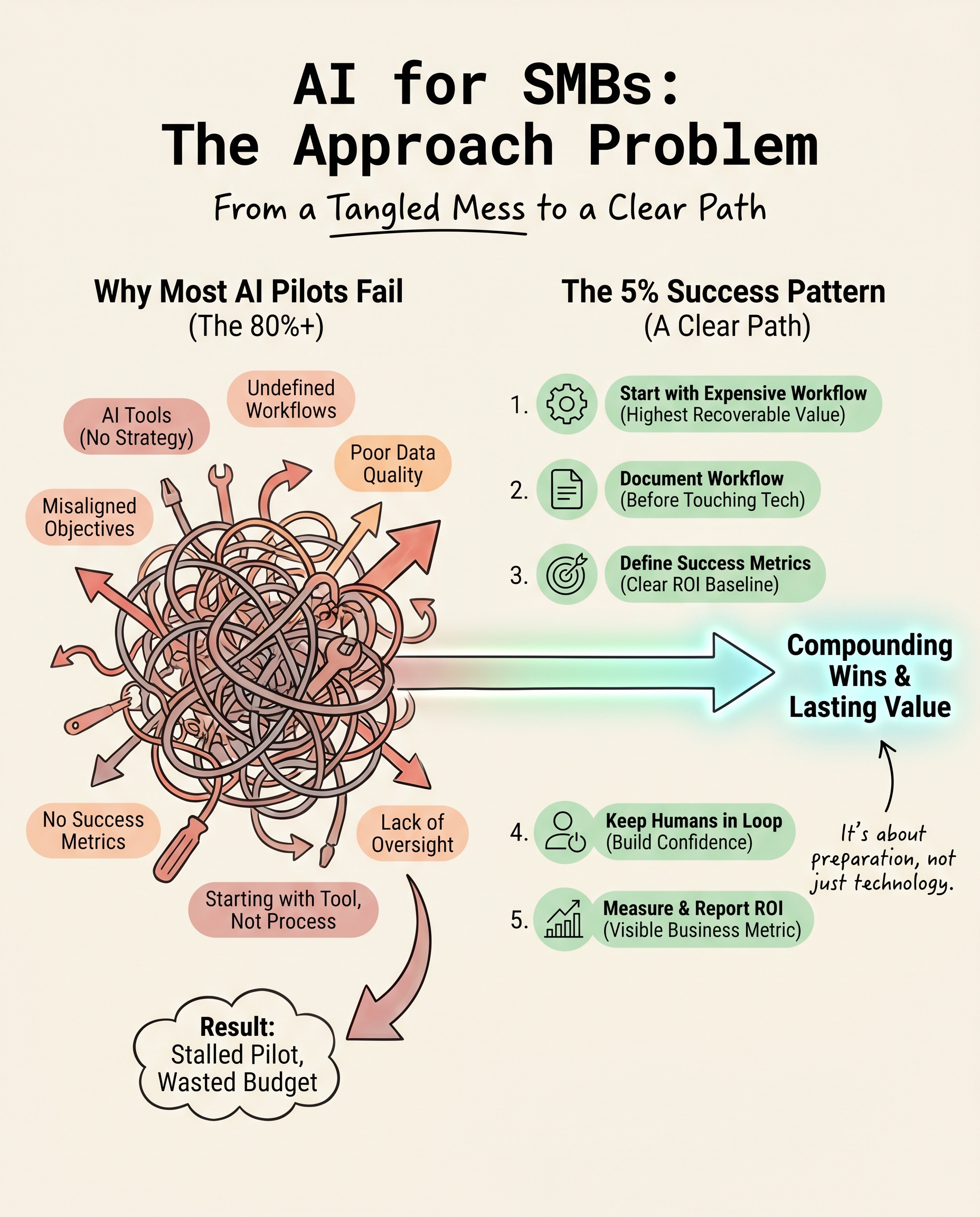
The odds are stacked against a typical AI pilot. Here's what the small group that beats those odds does differently, and how your business can join it.
Key takeaways
- Most AI projects fall short. Research suggests more than 80% fail to deliver the business value they promised, and small businesses have less room to absorb a miss.
- The cause is usually the approach. Projects stall when they start with software instead of a business process, and when nobody measures the result.
- The successful few share a pattern. They keep the scope narrow, document the steps, set clear targets, get fast feedback and keep people in the loop.
Walk into a small business that's experimenting with AI and the story often sounds the same. Someone on the team drafts emails with a chatbot. A manager tests an AI feature in the CRM. The owner signed up for a platform demo last month. There's real curiosity, some early experiments and a quiet worry that a competitor will figure this out first.
Then the pilot stalls. The new app goes unused, nobody measures anything, and six months later the conversation starts again with a different product. If that sounds familiar, the good news is that the fix is mostly in the approach, and you control the approach.
Why do so many AI projects fail?
The numbers are sobering. A 2025 RAND Corporation analysis cited by Pendoah found that more than 80% of AI projects fail to deliver their intended business value. The same roundup cites an S&P Global survey of over 1,000 organizations. It found 42% of companies abandoned most of their AI initiatives in 2025, up from 17% the year before.
For a large company, a failed pilot is an expensive lesson. For a small business, it can eat a real share of the year's technology budget, plus weeks of staff time. The stakes are different, so your approach has to be different too.
Data is a big part of the story. Gartner's 2025 research, cited in the same roundup, names poor data quality and unclear goals as the main cause of AI failure. It also notes that only 12% of organizations say their data is good enough for AI. In a small business, customer records often live in spreadsheets and key knowledge sits in someone's inbox. For you, that means the groundwork matters more than the software you pick.
Then there's the headline that spread everywhere. MIT research found 95% of organizations see no measurable return on generative AI spending. Read closely, it describes a deployment gap. Most AI investments never move from pilot into daily work. The path from demo to daily use is where projects break.
Why what you've tried probably hasn't worked
If you've bought AI tools and felt let down, you're in good company. The usual arc goes like this. A vendor promises time savings and someone runs a test. The test looks promising, so it rolls out. Use levels off, and within a quarter the new system fades away.
Starting with the tool. An AI writing assistant isn't a strategy. When the first question is "which AI tools should we use?" instead of "which process costs us the most hours?", the project has no solid base.
AI in every app. Most software now has an AI layer, and plenty of it is useful. But AI features inside disconnected apps don't fix scattered data. You end up with AI in five places, none of them connected, and no clearer view of your operations.
No measurement plan. If you don't define success before the pilot, you can't tell whether it worked. "The team seems to like it" won't justify more investment.
Thin vendor support. Salesforce's research on small business AI adoption flags weak support after the sale. You get a strong demo and a shallow onboarding. Then you're mostly on your own.
I find the pattern here telling. None of these failures is about what the AI can do. Each one happens in the planning around it.
The real cause sits in how the project is run
AI rarely fails because it can't do the job. It fails because the job was never defined clearly. The data wasn't clean, the team wasn't prepared and nobody was accountable for results.
PathOpt's analysis of the failure-rate data makes this point directly. The most common causes of failed pilots are leadership and buy-in problems, weak planning and a mismatch between what AI can do and what the business needs. Technical limits rank lower than most people expect.
Kodak is the cautionary tale here. In 1975, one of its own engineers, Steven Sasson, built one of the first digital cameras. The technology worked. Kodak later sold plenty of digital cameras, but it couldn't replace its film profits, and it filed for bankruptcy in 2012. Working technology doesn't help if the organization can't put it to use.
So the prep work is the project: mapping the work, cleaning the data, setting the targets and preparing the team. The businesses with lasting results did the foundations first.
Here's the part I find encouraging. Small businesses have a real edge. You can decide faster, change direction without layers of approval and adjust a narrow pilot in days.
5 things the successful few do differently
1. They start with the most expensive job.
The first question is "which recurring task eats the most hours each week?" Think proposal drafting, support triage, scheduling or copying data between systems. These aren't glamorous, but they pay back fastest. A 10-hour-a-week manual task, run for 50 weeks at a fully loaded hourly cost, adds up to tens of thousands of dollars a year.
2. They write down the steps before they touch the technology.
Before anyone picks a platform, they answer these questions in writing. What are the exact steps? Who does each one, and when? Where does the information come from and go? What does a good output look like? This is the input the AI needs to work. You can't automate work nobody has described.
3. They set success targets before the pilot starts.
First they measure the starting point: time taken, error rate and weekly hours. Then they set the target: what number, by what date, justifies a full rollout? That stops weak pilots from dragging on, and it gives good results real credibility.
4. They keep people in the loop, especially early.
The fastest adopters often resist full automation at the start. A human review step in the early months catches errors the system didn't anticipate, and it builds the team's confidence. Staff who review and correct AI outputs tend to become its biggest supporters.
5. They measure the return and share it.
The successful few treat AI returns like revenue and margin. They track hours saved each week, faster turnaround and fewer errors, and they share those numbers with the team and leadership. Early wins fund the next project. Our guide on building an AI strategy walks through the full decision framework.
For your business, these five habits cost little and need no technical team. They need clarity, honesty about your data and steady measurement.
What this looks like in practice
Here's a worked example. Picture a professional services firm that handles about 50 client intake forms a week. Each one needs someone to read it, pull out the key details, check existing records and route it to the right person. At 12 minutes each, that's 10 hours a week. At about $65 an hour, it costs the firm $650 a week, or roughly $33,000 a year.
Now picture an AI agent with clear intake rules, connected to the CRM, with a team member reviewing its work for the first month. In a setup like that, the weekly time can often drop to a few hours. The person who spent 10 hours on intake gets most of that time back for more valuable work. That's the kind of math that builds the case for the next project.
Plenty of businesses never get there, and the reasons repeat. They never mapped the work, never measured the starting point and never defined success.
Also: AI for operations and process improvement
Also: How to build an AI-ready organization before the software goes live
So what does this mean for you? I'd start small: pick one job, cost it out and write it down before you look at any software.
Ready to find out if your business is set up to succeed?
If you've tried AI and it didn't deliver, that isn't a verdict on whether AI can work for you. It tells you where the plan broke down, and the fix usually comes before the technology.
Our complimentary AI Readiness Assessment shows which part of your business has the most recoverable value. It also shows where your data and team stand, and what a realistic first project looks like for your budget.